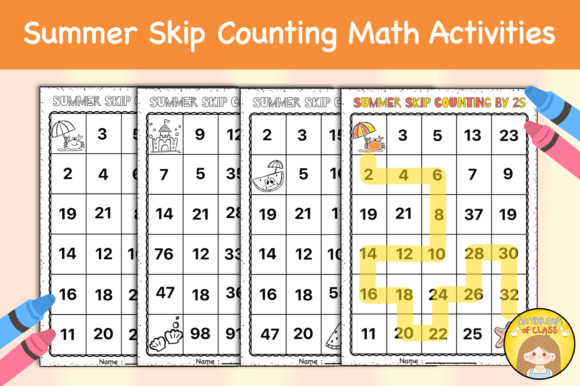
Summer Skip Counting Mazes: A Fresh Way to Keep Math Skills Sharp
There’s something about summer that makes even the most dedicated parent or teacher hesitate before mentioning the word “math.” You know the look—the one that says it’s vacation, not school. And honestly, I get it. Summer should feel different. But here’s the thing: it doesn’t have to feel like a compromise. When you bring in something like Summer Skip Counting Mazes, you’re not dragging a classroom into July. You’re giving kids a puzzle, a path, a bit of a challenge—and they often end up asking for more.
These mazes aren’t your typical drill sheets. They weave skip counting by 2s, 3s, 5s, and 7s into a playful, visual journey. And for the adults in the room—whether you’re a parent, a tutor, a camp leader, or a teacher planning summer enrichment—they solve a practical problem: how do you keep foundational math skills alive without burning anyone out?
Why Skip Counting Actually Matters This Time of Year
Skip counting is one of those quiet skills that doesn’t get the glory, but it shows up everywhere. When a child can count by twos fluently, they’re not just reciting numbers—they’re building the mental structure for multiplication and division. And during a long break, that structure can get wobbly.
I’ve seen it happen. A student who left first grade confidently counting by fives returns in the fall hesitating over 25, then 30. The summer slide is real, and it hits foundational skills hardest. But the mazes offer a low-stakes way to revisit those patterns. A kid might pick up a maze for seven minutes on a Tuesday afternoon, trace a path from 14 to 70, and then close the binder. That’s not a lesson. That’s a mental reset.
For adults, the value here is subtle but real: you’re not fighting for attention. The maze format naturally draws them in. And because the practice is built into the fun, you skip the negotiation altogether.
Parents Trying to Protect the Summer Break Vibe
If you’re a parent, you’ve probably felt the tension between wanting your child to retain what they learned and not wanting to be the person who assigns homework in June. With skip counting mazes, you can set a couple of pages on the kitchen table with a pencil and say “try this if you’re bored.” No pressure. No schedule. I’ve watched my own niece grab a maze while waiting for lunch, finish it, and then flip to the next one just to see if she could beat her time. That’s the kind of voluntary practice that actually sticks.
You don’t need a teaching degree to use them, either. The mazes are self-contained. The path shows the correct skip-counting sequence, so once a child finishes, they can self-check. That means you can fold laundry, check emails, or just sit with your coffee while they stay engaged with something productive.
Teachers Running Summer School or Enrichment Programs
For educators, summer sessions come with unique constraints. You might have mixed-age groups, short attention spans, and a mandate to review without reteaching. This is where Summer Skip Counting Mazes become especially useful. They aren’t grade-specific—a second grader can work on counting by twos while a fourth grader tackles sevens. Everyone gets a maze that matches their current comfort level, and because it’s a maze, it doesn’t feel like review.
I’ve seen teachers use them as a warm-up activity during the first five minutes of class, while students trickle in. Others set them up as a choice in a math station rotation. One teacher I spoke with laminated a set and let students use dry-erase markers, so the mazes lasted all summer across multiple groups. That little tweak saved her hours of photocopying.
Camp Counselors and Program Coordinators
This might surprise you, but summer camps can be a perfect home for skip counting mazes. Not every camp activity is high-energy. There are rainy days, quiet hours, and transition times between swimming and lunch. Having a handful of printed mazes in a folder means you can redirect a restless camper without pulling out a screen.
I’ve watched camp leaders use them as a paired activity—two kids race to see who finishes the correct path first. It becomes a game, not a worksheet. And because the mazes cover different skip-counting intervals, you can tailor the difficulty to each child’s capability without making anyone feel singled out. The sevens maze feels more advanced, so older campers get their own challenge.
Tutors and Homeschool Parents
If you’re working one-on-one with a child over the summer, you have the luxury of customization. You also face the challenge of keeping sessions fresh. With the mazes, you can bring variety without changing your entire approach. One day, count by threes. Next session, fives. The format stays familiar, but the target changes.
I’ve found the mazes especially helpful for kids who are resistant to timed drills. A child who tenses up when you pull out flash cards often relaxes when handed a maze. There’s no pressure to answer quickly—just a path to follow. Over time, that repeated exposure builds automaticity in a way that feels natural, not forced.
Choosing the Right Maze for the Right Moment
One practical observation I’ve made is that not all skip-counting intervals are equally useful at every stage. Counting by twos and fives often come more naturally because they appear in everyday life—number of shoes, fingers on two hands, coin counting. The mazes for threes and sevens are where the real growth happens.
If you’re using these with a younger child, starting with the twos and fives mazes builds confidence. Then you can introduce threes, which requires more attention to pattern. I’ve seen a third grader light up after finishing a sevens maze—she felt like she cracked a secret code. That moment of pride is worth more than a perfect test score.
For older students who have already learned multiplication, skip counting mazes still serve a purpose. They reinforce the patterns that lead to quick mental math. A child who can count by sevens fluently will later find division and fractions less intimidating. The mazes become a fluency builder that doesn’t feel remedial.
Practical Considerations Before You Print and Go
The “print and go” convenience is real, and it’s one of the strongest features of Summer Skip Counting Mazes. You don’t need to cut, laminate, or assemble anything. But there are a few things worth thinking about before you hand them out.
- Paper type matters. If you’re printing for one-time use, standard copy paper works fine. But if you want to reuse them across multiple children or sessions, a quick pass through a laminator or slipping them into a clear sleeve turns them into a lasting resource. A dry-erase marker makes them endlessly repeatable.
- Keep an answer key handy. Some mazes have trickier paths. Having a key saves you from having to work through each one yourself, especially if a child gets stuck and asks for help. It also lets them self-check if you want them to work independently.
- Match the maze to the child’s current fluency. A child who struggles with skip counting by sevens will benefit more from a twos maze done confidently than a sevens maze done with frustration. The goal is success, not struggle. You can always level up next week.
- Consider the timing. These aren’t meant to fill an hour. They’re five-to-ten-minute activities. That’s actually their strength. They fit into the cracks of a summer day—while waiting for dinner, after a swim, before screen time.
Where They Shine and Where They Don’t
Let’s be honest about strengths first. The mazes are engaging because they add a layer of purpose. Instead of just counting aloud, the child is solving a puzzle. They want to reach the end. That motivation is hard to replicate with standard worksheets. Plus, the summer theme makes them feel timely, not generic. Kids notice that it’s not a leftover worksheet from February.
Now for the limitations. Skip counting mazes focus narrowly on that one skill. They won’t teach story problems, geometry, or measurement. They’re a targeted tool, not a full curriculum. If you’re looking for comprehensive math review, you’ll need to pair them with other resources. But as a specific intervention or maintenance activity for skip counting, they do their job well.
Another thing to consider: some kids simply don’t love mazes. For those children, you might frame the maze as a challenge or a race against themselves. Or you might use only one or two and pivot to another activity. No single resource works for every child, and that’s okay. The mazes are flexible enough to fit into a larger toolkit.
Small Scenarios, Big Payoffs
I’ve seen a grandparent pull out a maze during a family gathering to keep a restless six-year-old occupied while the adults talked. I’ve seen a fifth grader use a sevens maze to warm up before a timed math test. I’ve seen a daycare provider print a stack to use during afternoon quiet time. Each scenario is different, but the common thread is that the adult in charge needed something quick, meaningful, and low-prep.
Summer Skip Counting Mazes fit that need. They don’t require explanation, setup, or cleanup. They work in the living room, the classroom, the camp pavilion, or the back seat of the car. And they quietly reinforce a skill that makes future math smoother for everyone involved.
If you’ve been looking for a way to weave a little math into summer without disrupting the feel of the season, this might be the simplest solution you’ll find. No lectures, no tears, no wasted time. Just a path from one number to the next, with a little fun along the way.